If you’ve ever Googled for help with your finances, you’ve probably noticed that the titles can feel interchangeable. Financial planner. Financial advisor. Wealth manager. Investment advisor. They all seem to mean roughly the same thing- until you start looking more closely.
These titles mean very different things, carry different credentials, and come with different approaches to how they work with you. Understanding the distinction can help you find the right person for your situation- and avoid working with the wrong one.
The Terms Are Not Regulated the Same Way
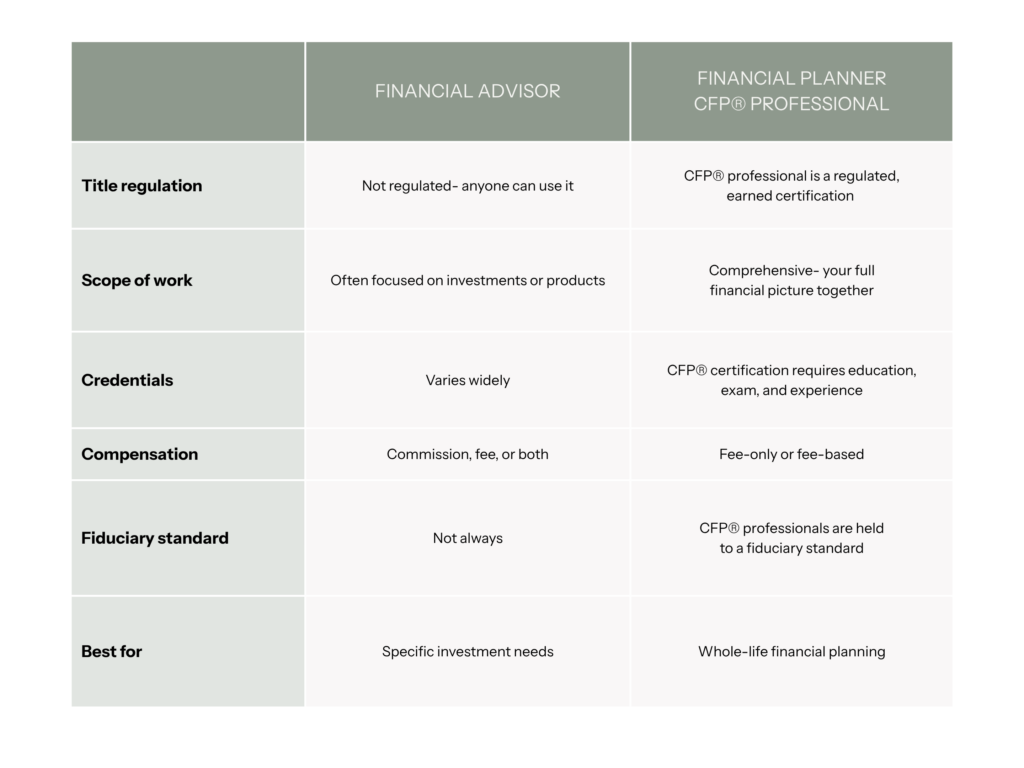
One of the most important things to understand: in the United States, the title “financial advisor” is not regulated. Almost anyone can call themselves a financial advisor- regardless of their education, credentials, or how they’re compensated. That’s not a criticism of everyone who uses the title, but it’s a reality worth noting.
“Financial planner,” on the other hand, carries more weight- especially when paired with the CFP® designation.
What Is a Financial Advisor?
“Financial advisor” is a broad, catch-all term that can describe a wide range of professionals. It may refer to someone who:
- Sells investment products or insurance
- Manages an investment portfolio
- Provides general financial guidance
- Works on commission, a fee, or both
Because the title isn’t regulated, the scope of work, compensation structure, and level of expertise can vary enormously from one person to the next. Financial advisors may hold various licenses depending on the services they offer. Some financial advisors are highly qualified and genuinely client-focused. Others may have a more limited scope or a compensation model that creates conflicts of interest.
What Is a Financial Planner?
A financial planner takes a more comprehensive, whole-picture approach to your financial life. Rather than focusing on a single product or investment, a financial planner looks at all the interconnected pieces (income, spending, taxes, insurance, retirement, estate planning, and goals) and helps you build a coordinated strategy that addresses all of them together.
The gold standard credential in financial planning is the CFP® certification- earned through the Certified Financial Planner Board of Standards. To earn the CFP® certification, a professional must complete an extensive education requirement, pass their CFP exam, accumulate thousands of hours of qualifying experience, and commit to ongoing continuing education and ethical standards.
A CFP® professional is a financial professional trained to understand the full complexity of a financial life and how every decision affects everything else.
Key Differences at a Glance
What Does “Fiduciary” Mean — and Why Does It Matter?
A fiduciary is legally required to act in your best interest- always. That sounds like it should be the baseline for anyone you hire to help with your money, but it isn’t.
Some financial advisors operate under a “suitability standard,” which means they only need to recommend products that are “suitable” for you- not necessarily the best option available. That distinction matters when you’re talking about recommendations that affect your retirement, insurance, and tax strategy.
CFP® professionals are held to a fiduciary standard as part of their certification. Fee-only advisors are paid directly by clients and receive no commissions.
Fee-Only vs. Commission-Based: Why Compensation Matters
How your financial professional gets paid has a direct impact on the advice they give. There are three main compensation models:
- Fee-only: The advisor is paid directly by you- through a flat fee, hourly rate, or percentage of assets under management. No commissions or product incentives.
- Fee-based: The advisor charges a fee but may also earn commissions on certain products they recommend. This creates a potential conflict of interest that’s worth understanding before you engage.
- Commission-based: The advisor earns money when you buy a product- a mutual fund, insurance policy, or an annuity. Their income is tied to what they sell, which can influence what they recommend.
When you’re looking for a financial planner to help with your full-picture financial life, fee-only is the structure that most cleanly aligns their interests with yours.
How to Choose the Right Financial Support for Your Situation
You may need a financial advisor if:
- You have a specific, narrow need- like purchasing a life insurance policy or rolling over a 401(k)
- You’re looking for someone to manage an investment portfolio and not your complete financial picture
You likely need a financial planner if:
- You carry the mental load of financial decisions and want a steady, organized partner to think through it all with you
- You want someone to look at your whole financial picture
- You’re navigating a major life transition- a new job, growing family, approaching retirement, divorce, or loss of a spouse
- You want a tax-smart strategy that coordinates your investments, savings, and income
Questions to Ask Before You Hire Anyone
Before working with any financial professional, ask these questions directly:
- What credentials do you hold?
- Are you a fiduciary?
- How are you compensated?
- What is included in your services?
- Do you coordinate with my CPA or other advisors?
- What does the ongoing relationship look like?
What This Looks Like at Method Financial Planning
At Method, Katie Burke, CFP®, is a fee-only fiduciary. That means she’s legally required to act in your best interest, paid directly by you with no commissions involved, and trained to look at your full financial picture- not just one piece of the pie.
The work at Method covers financial planning and investment management together: cash flow, taxes, retirement, insurance, estate planning, college savings, and major life decisions- all coordinated into one clear strategy.

The goal is always the same: a financial life that feels lighter, clearer, and aligned with what matters most to you.
If you’ve been wondering whether you need a financial planner, a financial advisor, or something in between- the best place to start is a conversation.
Schedule your free consultation call and let’s figure out what kind of support you need.